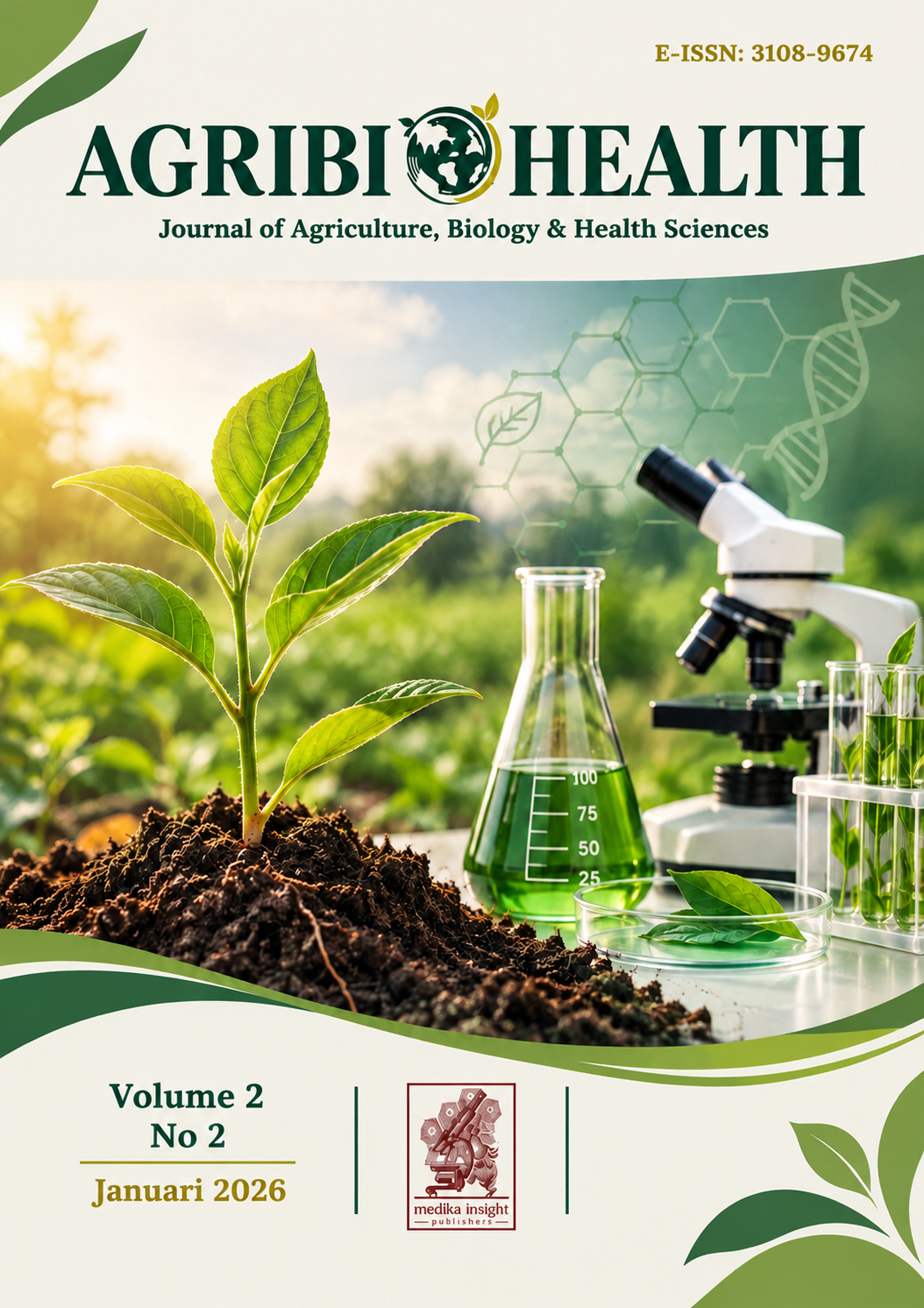
Pengetahuan Ibu Nifas Tentang Perawatan Luka Perineum Berdasarkan Status Pekerjaan
DOI:
https://doi.org/10.65318/agribiohealth.v2i2.37Keywords:
postpartum care, perineal wound, maternal knowledge, employment statusAbstract
Perineal wound care is an important component of postnatal care because inadequate care may delay recovery and increase the risk of complications. Employment may affect access to information, but its relationship with mothers’ knowledge is not self-evident. This study compared knowledge of perineal wound care between employed and non-employed postpartum mothers at Pleret Community Health Center, Bantul, Yogyakarta. A comparative cross-sectional study was conducted in February–July 2025 using total sampling of 30 postpartum mothers. Data were collected using a closed questionnaire comprising 30 items; correct answers received one point and incorrect answers zero. Descriptive statistics and the reported chi-square analysis were used. Overall, 21 respondents (70.0%) had good knowledge, five (16.7%) had moderate knowledge, and four (13.3%) had poor knowledge. Among employed mothers, 12/14 (85.7%) had good knowledge, compared with 9/16 (56.3%) among non-employed mothers. The reported p-value was 0.211, indicating no statistically significant difference at the 0.05 level. The small sample and limited reporting of questionnaire validity and test assumptions constrain interpretation. Postnatal education should therefore be provided to all mothers, tailored to individual information needs rather than employment status alone
References
World Health Organization, WHO Recommendations on Maternal and Newborn Care for a Positive Postnatal Experience. Geneva, Switzerland: WHO, 2022. [Online]. Available: https://www.who.int/publications/i/item/9789240045989.
A. M. Wojcieszek et al., “WHO recommendations on maternal and newborn care for a positive postnatal experience: strengthening the maternal and newborn care continuum,” BMJ Global Health, vol. 8, suppl. 2, e010992, 2023, doi: 10.1136/bmjgh-2022-010992.
“Postpartum management of perineal injury—A critical narrative review of level 1 evidence,” Midwifery, vol. 112, art. 103410, 2022, doi: 10.1016/j.midw.2022.103410.
J. Saad and C. Painter, “Management of postpartum perineal wound complications,” Current Opinion in Obstetrics and Gynecology, 2023, doi: 10.1097/GCO.0000000000000906.
R. Woga and M. S. Sekunda, “Pengetahuan ibu tentang perawatan luka perineum pada ibu post partum di ruangan nifas 3 RSUD Ende,” Kelimutu Nursing Journal, vol. 1, no. 1, pp. 22–29, 2022, doi: 10.31965/knj.v1i1.923.
R. Hidayati, Mariyati, and F. Hanum, “Hubungan pengetahuan dengan tindakan perawatan perineum pada ibu postpartum,” Jurnal Assyifa: Jurnal Ilmu Kesehatan Lhokseumawe, vol. 6, no. 2, 2021, doi: 10.54460/jifa.v6i2.16.
N. A. Indraswati, M. Ningsih, and D. R. Finarti, “Hubungan pengetahuan ibu post partum tentang perineal wound care dengan proses penyembuhan luka perineum di Poskesdes Sungai Kitano Martapura Timur Kabupaten Banjar,” Jurnal Integrasi Kesehatan & Sains, vol. 5, no. 1, 2023. [Online]. Available: https://ejournal.unisba.ac.id/index.php/jiks/article/view/10809.
O. Nedean, E. N. Sari, and H. Hafiza, “Hubungan tingkat pengetahuan ibu nifas tentang perawatan luka perineum dengan lama penyembuhan luka di wilayah kerja Puskesmas Koto Baru,” Bunda Edu-Midwifery Journal, vol. 6, no. 2, pp. 235–239, 2023, doi: 10.54100/bemj.v6i2.132.
L. Sidqi, “The relationship between the level of knowledge, attitudes and nutrition of postpartum mothers with the acceleration of healing of perineal wounds,” SIMFISIS: Jurnal Kebidanan Indonesia, vol. 3, no. 3, 2024, doi: 10.53801/sjki.v3i3.206.
S. Norlina, “Knowledge and attitudes of postpartum mothers in caring for perineal wounds in the independent practice of the Endang Midwife T S.S.T,” Jurnal EduHealth, vol. 14, no. 2, pp. 861–865, 2023. [Online]. Available: https://ejournal.seaninstitute.or.id/index.php/healt/article/view/2169.
Y. Y. Khasanah, A. Y. R. Dini, and W. A. Saputri, “The relationship between knowledge of postpartum mothers about perineal wound treatment with perineal wound healing,” Indonesian Health Journal, vol. 1, no. 1, 2022, doi: 10.58344/ihj.v1i1.9.
E. M. Schnittka, N. W. Lanpher, and P. Patel, “Postpartum dyspareunia following continuous versus interrupted perineal repair: A systematic review and meta-analysis,” Cureus, vol. 14, no. 9, e29070, 2022, doi: 10.7759/cureus.29070.
“Effect of tissue adhesives in repairing perineal trauma during childbirth: A systematic review and meta-analysis,” Journal of Clinical Nursing, 2023, doi: 10.1111/jocn.16086.
N. K. Juliani, R. Tedjasulaksana, and N. N. Budiani, “Gambaran pengetahuan ibu nifas tentang perawatan luka perineum di Rumah Sakit Umum Daerah Kabupaten Karangasem tahun 2023,” Archive of Community Health, 2025. [Online]. Available: https://ojs.unud.ac.id/index.php/ach/article/view/126749.
American College of Obstetricians and Gynecologists, “Optimizing postpartum care,” ACOG Committee Opinion No. 736, reaffirmed 2021. [Online]. Available: https://www.acog.org/clinical/clinical-guidance/committee-opinion/articles/2018/05/optimizing-postpartum-care.
Royal College of Obstetricians and Gynaecologists, “Perineal wound breakdown,” Patient Information, updated 2022. [Online]. Available: https://www.rcog.org.uk/for-the-public/browse-our-patient-information/perineal-wound-breakdown/.
National Institute for Health and Care Excellence, Postnatal Care, NICE Guideline NG194. London, UK: NICE, 2021. [Online]. Available: https://www.nice.org.uk/guidance/ng194.
Downloads
Published
Issue
Section
License
Copyright (c) 2026 Tita Restu Yuliasri, Arifah Istiqomah

This work is licensed under a Creative Commons Attribution-NonCommercial-ShareAlike 4.0 International License.